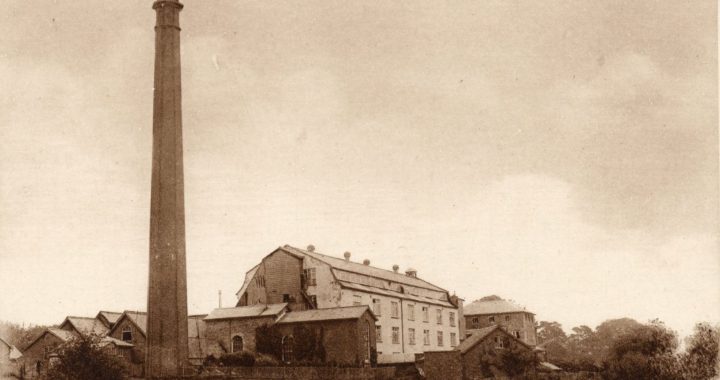
An article about Coldharbour Mill by Annie Saunter.
The tall, imposing, brick chimney of Coldharbour Mill can be seen for miles, reminding Uffculmites and others of the huge influence it has had on the village.
Dating back hundreds of years as a mill of various kinds – grist and paper to mention just two. There is a possibility that one of the two Uffculme mills mentioned in the Domesday Book could be Coldharbour. But it was the sale in 1788 to Thomas Fox that was to establish it as a very important part of the Devon wool trade. It is believed that textile production started in 1797. He developed the then small grist mill into a hive of woolly activity and employed many local people to work there, in circumstances which for the time, were fairly reasonable.
Thomas Fox was a Quaker, with strong ethics, so hours were shorter than some mills and working conditions better than other employment at the time. Over the next two centuries there were other improvements, such as healthcare and time for the young workers’ education (children over the age of eight were employed). Fox also set up a coffee house
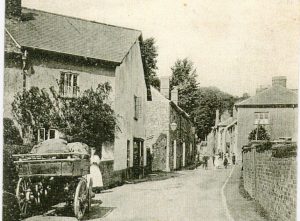
A view up Coldharbour from the Mill end of the lane
We have to remember how hard life was for the ordinary population in those years, so it was still a tough life.
Originally worked by water power, thanks to the splendid huge waterwheel and the ever-flowing River Culm, the mill changed to steam power in 1865, well after Thomas Fox’s death in 1822. By then the mill was run by his sons and grandsons.
The waterwheel continued to be used for the nightshift until 1978 as the beam engines etc would have been noisy to the surrounding roads and inhabitants.
Sadly the recession in the woollen industry forced a decline and finally the closure of the mill in 1981. Since 1982 it has been run as a working museum and still produces textiles. It welcomes visitors from far and wide and is a very popular educational trip venue for school students. Much work has been done and is still being done to save this, one of the best and last Georgian spinning and weaving mills in the country.
Check out Coldharbour Mill’s own website at www.coldharbourmill.org.uk