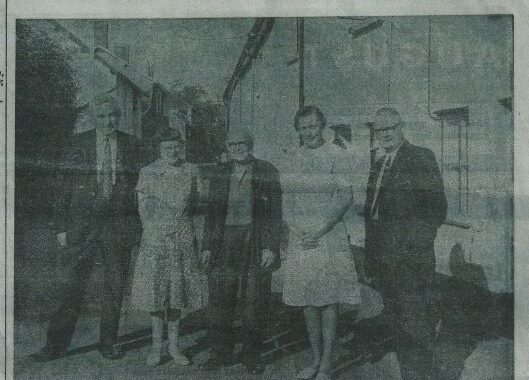
Thanks to an eagle-eyed Uffculme resident sorting out his sock drawer, a section of the Devon and Somerset News from 22nd August 1972 came to light. The newspaper was lining the drawer and Dennis Broom realised that it contained a fascinating article about Mill Street in Uffculme. Dennis kindly lent the paper to the History Group to make copies and here we have transcribed the article, by Oliver Greendell, which was clearly from a series run by the Devon and Somerset News “On the street where you live”. It provides some fascinating insights into Mill Street and some of its residents in the 1970s, including Jack Denner, a long-serving member of the Parish Council and, as Annie Saunter says in her article for the October edition of the parish magazine, Spotlight, “an all round good egg!”
Devon and Somerset News, 22nd August, 1972

On the street where you live
Aladdin’s cave of Uffculme history
Guide, Mr Jack Denner
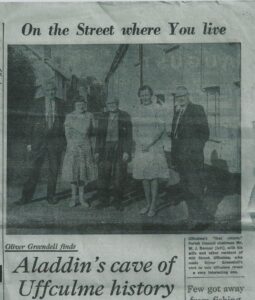
It is always absorbing to delve into the past, particularly when one has a knowledgeable guide. It was, therefore, very fortunate for me that when I visited Mill Street, Uffculme, I found a vast “Aladdin’s Cave” of history and a first-class guide in Mr. Jack Denner.
For 38 years Mr. Denner has lived at 5, Mill Street with his Halberton-born wife. He lived in nearby Kitwell Street as a boy.
Over the years Mr. Denner, a well informed local historian, flower grower, local government worker and school manager, has amassed a comprehensive collection of material concerning Uffculme’s past.
I was able to pore over numerous old photographs, cuttings and documents when I visited him on my meandering along Mill Street.
Beeching Axe
Born at Roach Cottage, at the top of Coldharbour, Mr. Denner was employed for many years on the railway at Tiverton Junction. He was at Uffculme Station for 10 years prior to its closure, then he was made redundant by the Beeching axe.
His gardening talents had by then been proved, and he has photographs showing Uffculme Station and Tiverton Junction ablaze with colour when they won awards for floral decorations.
Mill Street gained its name from the mill which once stood there. Belonging to Messrs. Small, it was gutted by fire and the work was subsequently transferred to the present site near the old railway station.
This was known as Bridge Meadow, and it was there that in 1912 about 1,500 people came to the local flower show and pony races. Uffculme personalities like “Dapper” Graves rode John Hancock’s pony to victory. Mr. Denner has documents dealing with these events – and he could tell me of the time when at Grantlands (now converted into separate dwellings) there were five gardeners on the staff, and exotic things like oranges and bananas flourished in the hot-houses.
How many Uffculme people, I wonder, ever knew that the village once boasted of two parrots. One, said Mr. Denner, lived at the Commercial Hotel – now re-named the Ostler – “and was supplied with beer”. The other was outside Nurse Clare’s. “We used to tease it and got the rough side of its tongue”, he joked.
Thank goodness
Thank goodness the days have long gone when places such as Mill Street were centres of abject poverty. Mr. Denner told me that over half-a-century ago the street was crowded with children, there being between five and eight in each home, and at the farm opposite upwards of 600 pigs were kept.
“The stench was something dreadful,” he said. “Offal from the local slaughterhouse used to be spread on the field opposite and hundreds of seagulls used to come here to tear it to bits and carry it away.”
Now, Mill street is a peaceful, pleasant rural backwater – away from the roar of modern traffic and a far cry from those insanitary days when, not surprisingly, epidemics swept through like a tidal wave.
“I can remember terrible outbreaks of scarlet fever and diptheria, and we used to see the Black Maria, as we called it, come every day to take people to isolation hospital,” he said. “One of the things I went on the Council for was to improve sanitary conditions,” remarked Mr. Denner.
He told me with some pride that Tiverton Rural Council now had modern disposal plants throughout their area. He has represented Uffculme on the Rural Council since 1956 and has been a Parish Councillor from 1946.
In addition to all his other interests, Mr. Denner gave much time to the Uffculme Labour Party and was agent for three general elections – twice for Mrs. Pat Duffy and once for Dr. John Dunwoody.
Future
“What about Uffculme’s future?” I asked him and he replied: “I think we have a good future ahead. I think Parish Councils will become more important with the local government changes.” He added, with his usual good humour: “I have always said you can rouse a village if you can rouse the vicar. Personally, I think he (the Vicar, the Rev G.M. Fraser) came here already roused and I hope this augers well for the future. I think it is a good thing to have a man of such dynamic personality among us.”
Mr. Denner hopes that by 1974 the capacity of the village sewage treatment works will be doubled and that this will allow more building to take place in the village.
People come and go everywhere, and Mill Street is no exception. But some people stay, and at No. 2, which has been their home since 1946, live Mrs. and Mrs. E.F. Dare. Mr. Dare was born in the village and now works in Exeter. For 18½ years Mrs. Dare was a member of the canteen staff at Uffculme Primary School and regards the time she spent there as “good old days”.
She told me she still tended to think of the children she knew as small until she sees them with children of their own!
Young at 80
To her Mill Street is “a lovely spot” and so it is to Mr. Jesse Hitchcott, the youngest 80-year-old I have seen for many a day, who has lived since 1939 at No. 7. A man with a wonderful memory, he says he can remember the past better than more recent times, he began work at the age of 12 “in service” at Bradfield House. He was a hall boy for the Walrond family and told me he could plough when he was only eight.
When he enlisted in the First World War it was his farrier’s skill, gained from local blacksmiths, which took him into the Royal Engineers. After the war he came back to work for several Culm Valley firms associated building.
“Uffculme has changed a lot,” he told me, remarking that many houses in the Mill Street area had disappeared and that village life had also changed.
Nice place
As far as he is concerned, however, Uffculme has “always been a nice place.” Mr. Hitchcott, whose wife died in 1945, has eight children. Five of them five live in the Culm Valley.
Bee-keeping was one of his great hobbies in his in his younger days, and he is renowned in the community for being able to catch rats with his bare hands! Although he says he has not had it all his own way in life, he was wounded three times in the First World War and had several operations, Mr Hitchcott truly epitomises his own words “I don’t feel my age.” And he doesn’t look it either!
What better tribute could there be to the tranquility of Mill Street!
[Click on the images below to see larger version of the copies of the original]
-
- Page 1 of the article about Mill Street, Uffculme, from the Devon and Somerset News 22nd August 1972
-
- Page 2 of the article about Mill Street, Uffculme, from the Devon and Somerset News 22nd August 1972
-
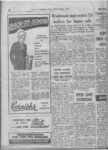
- Page from the same Devon and Somerset News 22nd August 1972 in which the article about Mill Street appears (this gives the date and some other fascinating adverts and snippets!)