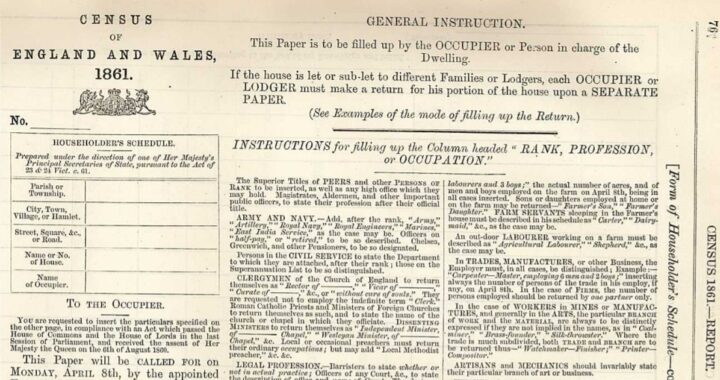
Annie Saunter, Chair of Uffculme Local History Group, writes:
April is upon us, and we can look forward to seeing ever more spring flowers, and hearing more birds, already busily nesting. There’s something else notable about the season for those of us interested in history, especially history of the family and the social scene: this is a census year.
A census has been taken every ten years, starting officially in 1841, except for 1941 during the war. There were censuses of sorts every decade from 1801, although it is generally accepted that the first modern census was taken in 1841. It was a fairly minimal one. It caused quite a bit of panic in Britain, as many people were afraid that giving information could lead to trouble. In 1841 people who became paupers through no fault of their own were liable to be sent back to their original parish, as they became a responsibility for the worthies of wherever they were living at the time of the census.
In reality the 1841 census was not exactly bursting full of information. Frequently the enumerators were not particularly well versed in penmanship themselves. Very often details collected were pretty sketchy, with people having no idea of their birth date or maybe not even knowing exactly where they were born. People were supposed to complete the form themselves – a real challenge when so many could not read or write!
From that 1841 census we do know that the most common occupation across the whole country was domestic servant. Almost a quarter of a million people worked in cotton manufacture. Curiously we learn from the government’s archived census information that the country boasted 571 fork makers, 74 leech bleeders and 5 ice dealers!
Over the next few censuses information improved but, again, it depended on the details being gathered by the house-to-house recorders and their success persuading people to complete the forms.
Very often we are told so-called facts in our early years and then upon researching, find those facts to have been embroidered to hide a truth. Thus are many family myths created and exposed! It is very often facts and snippets gleaned from census data which help us to build up a truer picture of our family history. It was still, during my childhood, considered shameful to have been born in a Workhouse or to have been a Workhouse inmate at some time. Now it is almost a badge of honour to find such a record for a family tree!
Sometimes people had no idea that a woman called Betty might in truth have been baptised Elizabeth, and so on, so we probably cannot really blame the recorders for the inaccuracies we encounter in the early census data. Recorders would often have to make wearisome repeat visits to households not at home when they called. People were very suspicious of them and probably even hid from them in early years before the censuses became better understood and accepted.
Despite these limitations, census records do of course provide an absolute wealth of information for family and social historians. Judging by the number of enquiries on our website, people are more interested in tracing their ancestors than ever before. And with so much information now available online it makes it possible to do that research from the comfort of one’s own chair.
Census information about individuals is not, of course, released for 100 years. So have no fear, by filling in your 2021 census form, you will not be in danger of being banished back to your original parish and the information you provide may be prized by future generations! If you are interested in the history of the census in the UK, you can find more information on the government’s official website in the history section. Here’s the link to that.
Online events
Don’t forget our continuing programme of online events. Our April talk will be of great interest to many people locally, being about the history of Gaddon House. You can find more information on the events page.
How did you get on gazing around at windows in the village for last month’s quiz? You can find the answers here. Once we started looking, there were so many interesting windows that for April’s quiz we have another batch of fascinating fenestrations (!) to test your powers of observation.
Stay safe and enjoy the return of some small freedoms.
Annie Saunter
Chair, Uffculme Local History Group