We were contacted in early 2022 by someone who had been researching his family history and discovered some of his ancestors in Uffculme, dating back to the 17th century and with a his third great grandfather running the London Inn in High Street in the 1840 and 1850s. Pete got in touch with us via the website contact form and said he was planning a visit – would anyone be available to do a bit of a tour with him? So here’s Pete’s own story:
Pete Fraser, visit to Uffculme February 2022
I first became interested in my family tree over fifty years ago, interviewing elderly relatives when I was still in primary school. At seventeen, when taking A level History, I had the opportunity to undertake an optional paper involving a 5000 word dissertation and oral exam, for which I investigated my father’s side of the family on Tyneside, including research at the records office in Durham looking at census returns on microfiche.
But for forty years, a box file of interview notes, printouts and the dissertation sat unopened; then in 2017 I decided it was time to resurrect the research and see whether the digital world could take me back further than the nineteenth century.
The Uffculme Connection
I quickly discovered that my mother’s family, the Dunsters, hailed not from the castle in Somerset of the same name, as she and her sister had been told as children, but from a ‘peculiar parish’ in Devon called Uffculme. Finding Philimore’s parish records online was a revelation, as they took me back at least 150 years further than I had managed before; a fourteen day free trial subscription to ancestry.com not only reinforced most of what I had previously discovered but also enabled contact with a cousin in Australia who had been engaged in researching the family history too. We each helped the other tweak what we had found and she forwarded some papers from her uncle, John Dunster, who had commissioned some research in the Devon records office in the 1990s which again largely confirmed what I had found.
It appeared from all this that my branch of the Dunster family were in Uffculme from the first half of the seventeenth century – possibly earlier – and stayed till the 1850s. Another John Dunster, possibly my ninth great grandfather, is listed in the Protestation Returns of 1642 and my third great grandfather, Richard Dunster, moved his family and bootmaking skills to London in 1854.
Alongside my use of online parish records, the findmypast, ancestry and British newspaper archive sites, I came across Uffculme local history group and learned a lot more about the place; I decided to make a trip down from Suffolk to soak up the atmosphere … but then Covid came and the trip was put off. A new year resolution for 2022 to really get on with the family history research spurred me on to book a trip. I saw the Heritage board online and thought that maybe I’d just use that as the guide for a stroll round the place but then, having booked airbnb at Smithincott Barton Farm, I decided to try a speculative email to see whether anyone from the local history group would be willing to be my guide.
A tour of the village
Generously, Jeni and Annie offered to show me round and I thoroughly enjoyed their tour which brought much that I had read in the books ‘A Peculiar Parish’ and ‘A Culm Valley Parish’ to life. On our walk, we stopped at the London Inn, where Richard Dunster had been landlord in 1841, in addition to his bootmaking, and the current occupant kindly let us in to have a look. Later we bumped into society president John Bell – whose chapters in ‘A Culm Valley Parish’ I had previously read – standing in the back garden of his cottage in Mill Street. He pointed out that another John Dunster, probably my sixth great grandfather, had lived in one of those very cottages in 1780.
In researching the history of other branches of my family, in London, Tyneside and Carlisle, I have often been able to find the streets on which they lived and worked, but any pre-twentieth century dwellings were always long gone and newer ones built in their place. Though I have found churches, pubs and even castles which they would have passed daily, their towns have on the whole changed beyond recognition. In the centre of Uffculme, however, where so many of the buildings remain from 200 years ago or more, it really felt like I was walking where their feet had trodden and seeing much of what their eyes had seen.
Thanks again to Jeni, Annie and John for their generosity, enthusiasm, expertise and insights – I learned a lot on my visit and shall return!
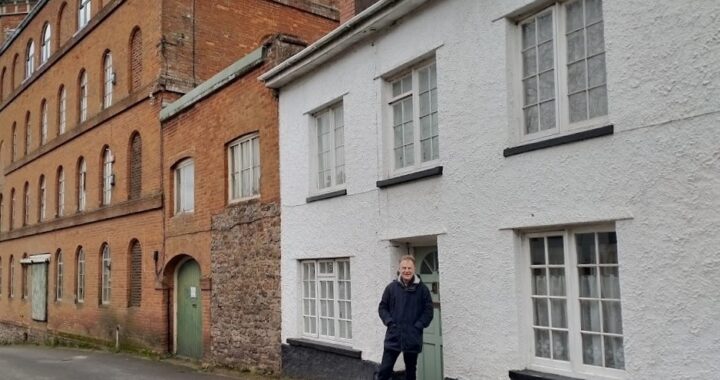
Thanks to Pete for this interesting article (and for lunch at Bridwell, say Jeni and Annie!). The photo is of him outside the house that was once the London Inn, with the Furze Brewery next door – very apt, as the son of that Richard Dunster married Elizabeth Furze, a relative of brewery founder William Furze. Pete also sent a copy of a cutting from the Western Times of 1843 describing the court case resulting from Richard Dunster’s journeyman and a friend stealing £5 from him. (Click on the image to enlarge or increase your screen size to make it legible!)
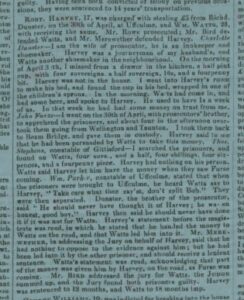
Another news item in the Western Times of November 1854 tells readers that “Richard Dunster, the late obliging landlord of the London Inn, has, much to the regret of the musical amateurs of this place, taken his departure from the neighbourhood. He was a member of the Uffculme band and also formed one of the party of glee singers established in the parish and in each capacity his services were highly appreciated by his fellow townsmen”.
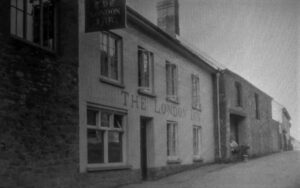
This very much later image of the London Inn, possibly from around 1960 was found on a website of closed pubs. (Picture credit: Clive Schneidau)