For my wife Jenny and myself, the archaeologist Courtenay Arthur Ralegh Radford (1900-1998) has been a powerful presence. We live in the house in Uffculme that was his home for nearly half a century – the first, in a peripatetic life, that he had owned. Home comforts, though, were never a priority. His cousin George Radford, who knew him well, recalled the house, ‘Culmcott’, being ‘still in its pre-war layout with coach house, stables, apple store, servants’ hall, pantry, scullery etc, much as it had been sixty years ago’.
That was how we found it when we arrived in 1999. I can report that we no longer have servants in the ‘servants’ hall’, but we have left the coach horse stalls untouched. There are plenty of other reminders of his presence. The more valuable of his possessions went to museums or archives, and others were auctioned off, but some things were just left in the house – a well worn Persian carpet, a framed portrait of his grandfather Daniel Radford, some old books and photograph albums, plenty of crockery, even a piece of stained glass dating – so John Allan tells me – from the fifteenth or sixteenth centuries.
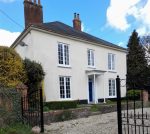
Culmcott as it is today
” … he is remembered as a genial but slightly eccentric figure … “
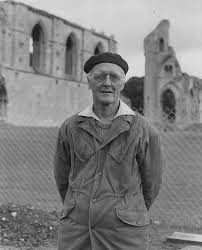
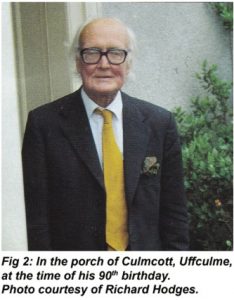
In Uffculme he is remembered as a genial but slightly eccentric figure. He was often to be seen – whatever the weather – in his characteristic shorts and beret. Whilst a very private person, whom few people knew well, he was gregarious and was involved in village affairs, particularly as a churchwarden of St Mary’s Church in Uffculme. Visitors from the world of archaeology would come to stay, undeterred, it seems, by the spartan conditions at Culmcott. One of them, in the early 1970s, was Maria Bersu, widow of the famous German archaeologist Gerhard Bersu, who had been a close friend of Ralegh Radford’s since the 1930s. She had fond memories of walks along the river Culm and sherry afterwards.
His Life and Work
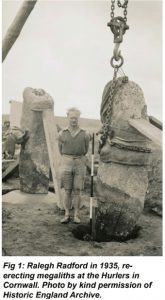
All of this has made me curious to know more about Ralegh Radford’s life and work. It was not difficult to find out about his career. He wrote extensively, there were plenty of obituaries and he appears in numerous archaeological memoirs. He was considered one of the leading archaeologists of his day, alongside figures like Sir Mortimer Wheeler, Sir Cyril Fox, Gordon Childe, O. G S. Crawford, and Christopher Hawkes – all of whom he knew well. He won every archaeological award going and others besides, including an OBE for his intelligence work during WW2. He made a huge contribution to the work of national organisations like the Society of Antiquaries and the royal commissions on historical monuments, as well as to local archaeological societies, and was a prolific book reviewer. His special interest was the archaeology – particularly the medieval archaeology – of the three counties of Cornwall, Devon and Somerset. Tintagel and Glastonbury were his most important excavations but there were many others.
What is a bit more of a mystery to me is why today, given his multi-faceted contribution to archaeology, he has been so largely forgotten. Perhaps, as has been suggested, in an era of increasing specialisation he was just too much of a polymath, and too much of a romantic, preferring to move on to the next discovery than pause to synthesise his ideas in full-scale monographs or reports. Many of his ideas and interpretations, it is true, have been overturned or disproved by subsequent work and scholarship, but he is far from unique in this. I also think he has been judged from too narrow a standpoint, undervaluing other aspects of his work – for example the dozens of guides to historic sites and monuments which he wrote, or his work – not least in Devon – in helping to preserve the fabric of countless medieval churches.
Brian Willan
This article was published in the Devon Archaeological Society journal in 2023 whilst researching the life and work of Ralegh Radford and called on members of the DAS to contribute any information or memories they had. Brian presented a talk to Uffculme History Group in 2024 and, on behalf of the group, went on to organise for a Blue Plaque to be put up at Culmcott to mark Ralegh Radford’s former home and celebrate his life and career. This will be unveiled on 16th May 2026. (See details on our events listing page.)